
From project spend to a reconciled register.
Finance teams need to show where an asset's value came from and that the asset still exists. assetziq keeps each stage on record and checks the register against operational data.
- Three-way matching
- CWIP to capitalization
- Maker-checker
- Register reconciliation
- Lifecycle trace
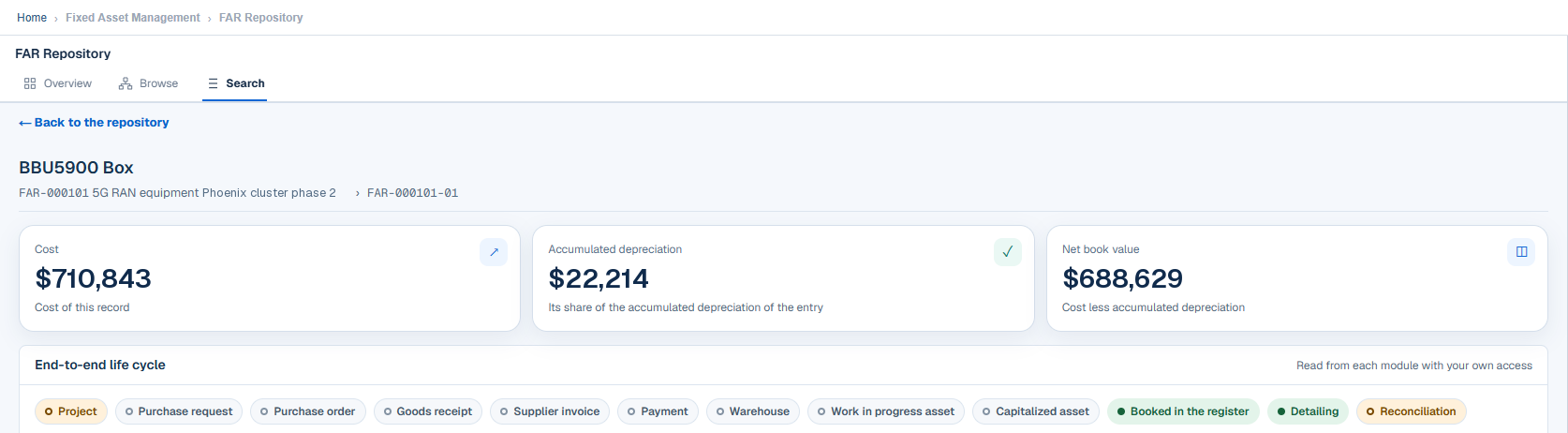
Eleven stages, visible for a single asset.
The register repository shows how far each asset has travelled, looking up related records by purchase order, project or serial number.
- Project
- Purchase request
- Purchase order
- Goods receipt
- Supplier invoice
- Payment
- Warehouse
- CWIP
- Capitalized
- Fixed asset register
- Reconciliation
Spend, capitalize, register.
Capital work in progress
Track budget, committed, incurred and accrued amounts per project until the work is complete.
02Capitalization
Approve full or partial capitalization. Financial fields lock once the asset is capitalized.
03Fixed asset register
Detail booked entries under maker-checker approval and keep net book value on every record.
Check the register against what operations hold.
Rule-based runs compare the register with network inventory, warehouse inventory and contracts, on demand or on a schedule.
How reconciliation works- Matched: the register and the source agree
- Mismatch: found, but details differ
- Not found: in the register, absent from the source
- Not in the register: in the source, missing from the register
- Needs physical check: a person must confirm
Built for audit, not added afterwards.
Maker-checker
In the register, the person who approves must differ from the person who submits.
Three-way matching
Invoices beyond tolerance against order and receipt are put on hold.
Field locking
Financial values are protected once an asset is capitalized.
History
Status and audit history are written with each business change.
Finance questions, answered.
Does assetziq replace our accounting system?
No. assetziq governs the asset record and the evidence behind it. Ledger account and journal references are recorded on the asset so the two can be tied together.
How is net book value handled?
Cost and accumulated depreciation are held on the record, and net book value is derived from them.
Can we load our existing register?
Yes. Register entries, capital work in progress and capitalized assets can each be imported in bulk using a template, with import history kept.
How do we find assets that are on the books but not in the field?
Reconciliation returns those records as not found, and flags others as needing a physical check. Each difference is then proposed and resolved by two different people.
Does procurement feed the register?
The register repository traces an asset back through its purchase request, purchase order, goods receipt, invoice and payment, so the origin of the value is visible.
Walk through the finance flow.
Bring a sample of your register and we will show detailing, capitalization and reconciliation end to end.